


ERF 2026
13th workshop on Hybrid Production Systems

The flagship event of the European robotics community, European Robotics Forum 2026 (ERF2026), took place from 23rd–26th March 2026 in Stavanger, Norway. ERF2026 marked its 16th edition and attracted over 1,000 participants from the academic, private, and public sectors. It included workshops, keynotes, and numerous exhibitors, and participants were able to attend the premier exhibition of universities and research organizations. ERF2026 showcased the latest advances, technologies, and robotics and Artificial Intelligence (AI) funded projects from the European Union (EU). ERF2026 was the first event of its kind and served as an opportunity for practitioners, researchers, engineers, entrepreneurs, and policymakers to collaborate and exchange ideas on innovations in AI and robotics, as well as on ways to enhance the competitiveness of Europe.
In this context, the 13th Hybrid Production Systems (HPS) Workshop at ERF 2026 was held on March 24th. The workshop explored the evolving balance between automation and human-centric production. It focused on how robotics, Artificial Intelligence (AI), and human factors are shaping the next generation of flexible, adaptive, and collaborative production systems.
The key themes included:
- R&D trends in robotics and AI for human-centred production systems
- Learning, upskilling, and reskilling for next-generation technologies
- AI-enabled robot cognition using Large Language Models (LLMs) and Vision-Language Models (VLMs)
- Perception, simulation, and digital environments for flexible production
- Safe and adaptive human–robot collaboration in industrial environments
- Human-in-the-loop approaches and immersive technologies (VR/AR)
The presentations included keynote talks and short impulse presentations from prominent speakers across industry and academia, highlighting state-of-the-art technologies, identifying industrial challenges, and enabling the development of new solutions. Additionally, a moderated round-table session took place, featuring interactive panel discussions that aimed to engage the audience in open dialogue and exchange ideas on the future milestones and definition of HPS.
Want to learn more? Click the Logos and learn about the Projects involved!




Summary of the Workshop
The 13th Workshop on Hybrid Production Systems (HPS) was moderated by George Michalos (Laboratory for Manufacturing Systems and Automation – LMS, University of Patras). He opened the session with a concise overview of previous HPS activities and introduced the workshop’s main thematic pillars. The workshop attracted more than 60 participants from both academia and industry, reflecting strong interest in the field.
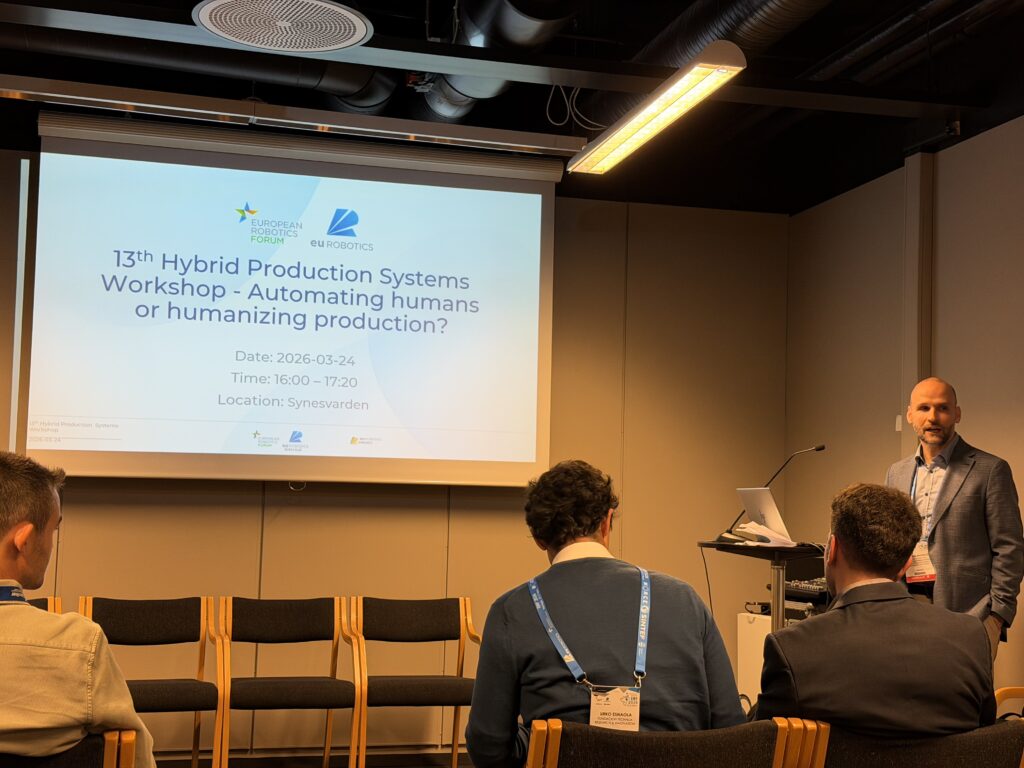
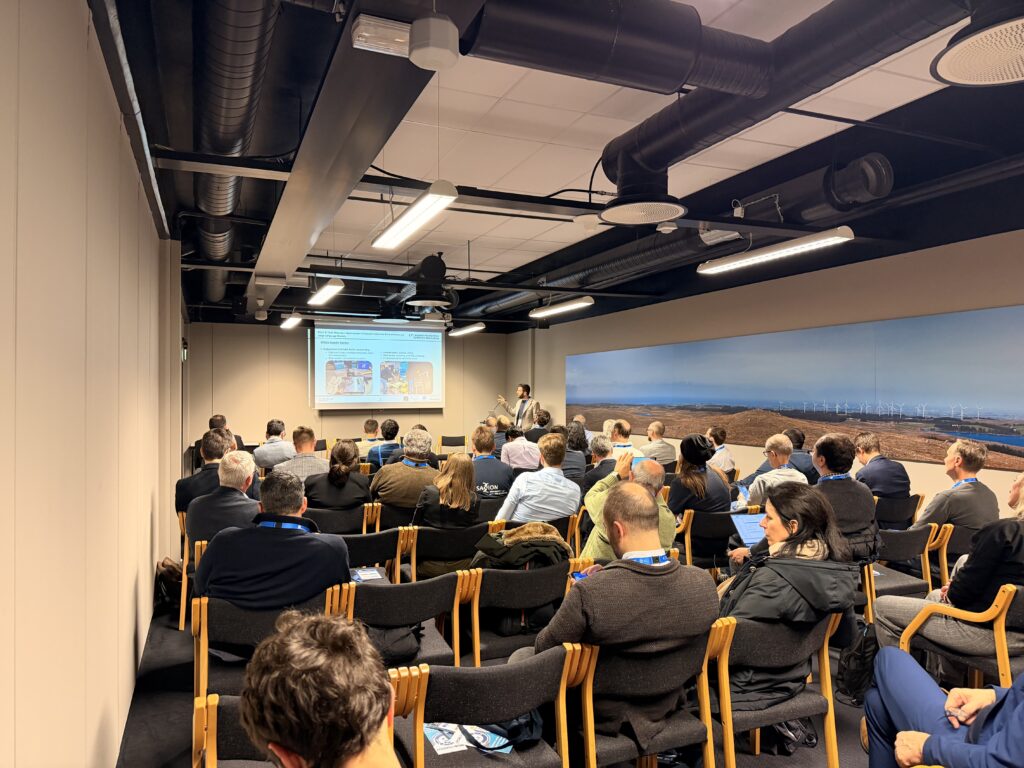
The workshop aimed to present current R&D trends in robotics and Artificial Intelligence (AI) for human-centred production systems, with a focus on AI-enabled robot cognition, flexible production through simulation and digital environments, and safe human–robot collaboration. It also addressed workforce upskilling and human-in-the-loop approaches supported by immersive technologies (VR/AR). The session featured keynote and pitch-style presentations, concluding with an interactive roundtable discussion to engage the audience.
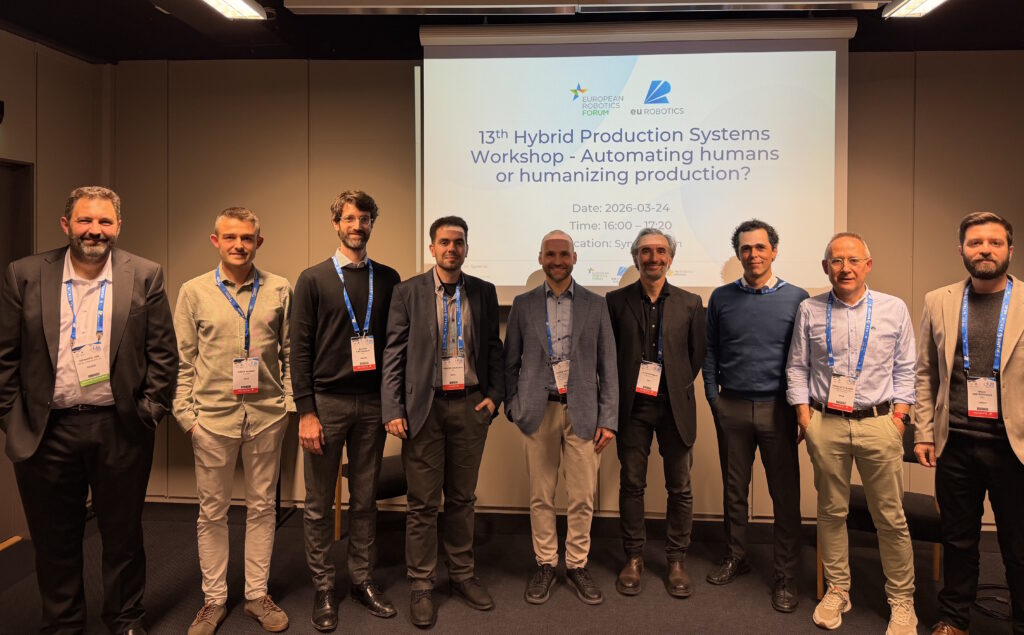
Key Contributions
Keynote:
“Learning, upskilling and reskilling for new robotics and AI technologies”
– Presented by Alfio Minissale, COMAU
– The keynote highlighted the importance of workforce development in the era of AI-driven automation, showcasing training frameworks and innovative learning environments that support skill transformation and continuous upskilling in modern industrial settings.
Pitch Talks:
- From the Laboratory to the Plant: Integrating the Operator into Intelligent Automation in the Food Sector
Ander Iriondo – TEKNIKER
Presented human-centric approaches for integrating operators into intelligent automation workflows, demonstrating real-world applications and user acceptance in industrial environments. - Show, Tell, and Deploy: Humanizing European Production through Imitation, VLMs, and Humanoids
Urko Esnaola – TECNALIA
Introduced novel methods for robot programming through demonstration, vision-language models, and humanoid systems, enabling more intuitive and human-oriented interaction with robotic platforms. - Task Allocation Optimization in Hybrid Production Environments via Large Language Models
Nikos Dimitropoulos – LMS, University of Patras
Demonstrated the use of LLMs for optimizing task allocation between humans and robots, validated through real-world and simulated industrial scenarios. - Empowering the Green Workforce: Hybrid Production Systems for the Future of Sustainable Re-X Processes
Dionisis Andronas – LMS, University of Patras
Addressed the challenges of circular manufacturing, emphasizing the role of human workers and AI-driven systems in enabling sustainable, flexible, and adaptive Re-X processes. - VR/AR Assisted Robot Programming by Demonstration in Human-Robot Collaborative Scenarios
Juan Francisco Blanes Noguera – Universitat Politècnica de València
Presented immersive XR-based approaches for intuitive robot programming, enhancing human–robot collaboration through demonstration and digital twin environments.
Main Outcome
The workshop combined expert presentations with active audience engagement to explore key challenges and future directions in human-centric, AI-driven production systems. Live polling via Slido provided valuable insights from participants representing academia, industry, and research organizations, highlighting both technological opportunities and critical concerns around human–machine collaboration.
Questions and Results:
- What type of organization do you represent?
- Academia – 43%
- Industry (End User) – 0%
- Industry (Technology Provider) – 22%
- Research & Technology Organization (RTO) – 17%
- Government – 13%
- Other – 4%
- What is the key missing capability for true human–machine symbiosis in production?(Open responses)
- “Mutual understanding”
- “Trustworthy models of reality”
- “Natural interaction”
- “Safety of HRC workflows”
- “Human acceptance”
- “Lifelong reskilling”
- Where does ‘human-centricity’ currently fail in practice?
- Used as a conceptual label rather than an engineering principle – 45%
- Not a real priority in industrial deployment – 45%
- Conflicts with productivity optimization – 30%
- Reduced to ergonomics, ignoring cognition – 25%
- Not measurable in system design – 25%
- Other – 5%
- What is the real direction of current AI-driven production systems?
- Humans are adapting to machine logic and constraints – 44%
- Both trends are equally present – 25%
- Machines are becoming more human-like – 13%
- Neither – 13%
- Other – 6%
- In practice, where should AI not be given decision authority? (Open responses)
- “Life and death decisions”
- “Final decision-making without human confirmation”
- “Security and human resources”
- “Creative tasks and innovation”
- “Situations outside trained knowledge”
- “Quality inspection and critical operations”
These results highlight a strong awareness within the community of the challenges in achieving true human–machine symbiosis. While there is clear progress in AI capabilities, participants emphasized the need for trust, transparency, and meaningful human involvement in system design. The findings also reflect a critical view of current “human-centric” approaches, pointing to a gap between conceptual frameworks and real industrial implementation, as well as ongoing concerns about the limits of AI autonomy in decision-making.