


ERF 2025
12th workshop on Hybrid Production Systems
The European Robotics Forum 2025 (ERF2025), the premier gathering of the robotics community in Europe, took place for the first time in Germany from March 25–27, 2025. The 15th edition of the conference attracted over 1,000 experts from academia, industry, and related sectors. ERF2025 featured a major exhibition where leading companies, universities, and research institutes presented the most advanced European prototypes, products, services, and projects funded under the EU’s Horizon 2020 and Horizon Europe research programs in robotics. Researchers, engineers, managers, entrepreneurs, business professionals, and public funding officers from across Europe gathered to discuss how synergies between robotics and artificial intelligence could drive innovation and boost the industry in the coming years.
In this context, the 12th Workshop on Hybrid Production Systems (HPS) was held on March 25th. The workshop was divided into several parts, focusing on key topics within Hybrid Production Systems, such as robotics, AI, human-robot collaboration, and flexible production processes. The key themes included:
- R&D trends for robotics and AI
- Open-world reasoning and generative AI for robot cognition in human-robot collaborative applications
- Perception and simulation as cognitive capabilities for versatile handling of products
- Safe and adaptable behaviour for flexible cognitive manufacturing in hybrid workplaces
- Human safety and novel methods for HRC in industrial settings
Each part consisted of targeted sessions, featuring presentations from prominent speakers across industry and academia. These included:
- Impulse presentations on the latest research projects, highlighting the industrial challenges they aimed to solve, real-life case studies, and enabling technologies
- Interactive panel discussions, designed to engage the audience in open dialogues with panelists and encourage the exchange of ideas on milestones achieved and the key challenges for the future of HPS
ERF2025 promises to be an invaluable opportunity for academic researchers, industry professionals, and entrepreneurs to stay on the cutting edge of technological developments and to discuss the key challenges that will shape the future of robotics and AI in production systems.
Want to learn more? Click the Logos and learn about the Projects involved!





Summary of the Workshop
Dr. George Michalos (Laboratory for Manufacturing Systems and Automation – LMS, University of Patras) opened the 12th edition of the Hybrid Production Systems (HPS) Workshop by welcoming the participants and presenting a brief recap of previous HPS activities. The session was well attended, attracting approximately 130 participants from academia and industry.
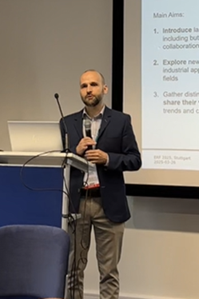
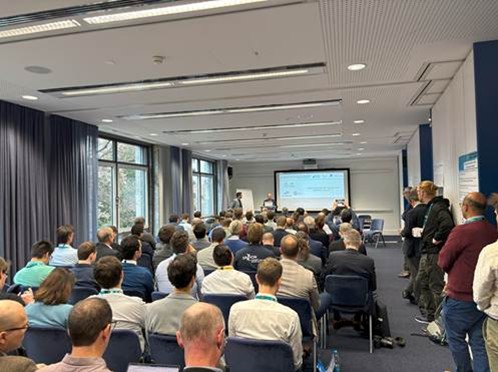
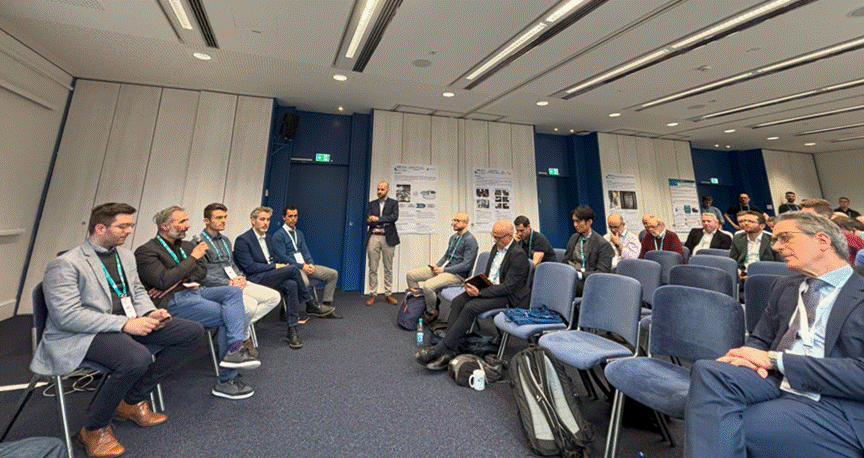
The workshop aimed to present recent advances in flexible production systems with a strong emphasis on AI integration, human-robot collaboration, and cognitive manufacturing. It featured a series of keynote speeches and pitch-style presentations, concluding with an open roundtable discussion to engage the audience.
Keynote 1:
“Research for Innovation at KUKA: Exploring Low TRL Projects and Future Directions in Robotics”
– Presented by Dr. Volker Schmirgel and Dr. Kirill Safronov, KUKA
– The keynote showcased how KUKA supports early-stage research through its structured TRL-driven development process.
Keynote 2:
““AI and cobots: new directions in Human Robot Collaboration”
– Presented by Alfio Minissale, COMAU
– The keynote introduced advancements in collaborative robotics, focusing on modular robot systems for confined-space inspection and depalletizing
Pitch Talks:
- Advancing Robot Cognition with Gen AI
Nikos Dimitropoulos – LMS, University of Patras
Demonstrated the use of GenAI in training robots for visual recognition and task planning, with remote inspection use cases in aeronautics. - Towards Zero Programming: Watch & Work Robots
Urko Esnaola – TECNALIA
Proposed XR and conversational interfaces for non-experts to program robots intuitively. - Open-World Reasoning for Human-Robot Collaboration in Remanufacturing
Christos Gkournelos – LMS, University of Patras
Presented a perception-augmented reasoning system for robotic disassembly in remanufacturing, with human-in-the-loop and LLM integration for adaptive behavior. - Virtual to Reality: Simulation-Driven Grasping
Ander Iriondo – TEKNIKER
Explored simulation-based learning for robotic grasping using synthetic data and real-world validation. - Human Role in AI-Powered Cognitive Manufacturing
Antonio M. Ortiz – NORCE
Addressed ethical, ergonomic, and upskilling dimensions in AI-augmented workplaces - Safe Human-Robot Collaboration with AI
Dr. Nicola Pedrocchi – STIIMA-CNR
Focused on AI-driven motion planning, risk assessment, and safety measures in collaborative industrial environments.
Main outcome
The workshop combined expert presentations with audience interaction to identify trends and challenges in AI-powered flexible production. Live polling via Slido provided useful insights from the audience, which included participants from academia, RTOs, and both end-user and technology-provider industries
Questions and Results:
- What type of organization do you represent?
- Academia – 27%
- Industry (End User) – 19%
- Industry (Technology Provider) – 23%
- Research & Technology Organization (RTO) – 19%
- Government – 0%
- Other – 12%
- Which technologies are low-hanging fruits for industrial applications?(i.e. already sufficiently mature)
(Multiple answers allowed)- Simulation-Based Model Training and Virtualization – 63%
- AI-Driven and GenAI-Based Robot Programming – 37%
- Safe and Human-Centric Collaboration in HRC Systems – 13%
- Knowledge-Based and Cognitive Planning – 10%
- Other – 3%
- How can conversational interfaces and program-by-dialogue systems reshape the interaction between workers and robots on the shop floor?(Open responses)
- “Knowledge transfer”
- “Faster training of personnel”
- “Evaluation of cognitive workload”
- “Detect intentions”
- “Stress and general health condition monitoring”
- “Conversational interfaces may be more suitable for service/edutainment robots than industrial shop floors”
- “By making robots more intelligent, do we risk de-skilling the operators?”
These results reflect both enthusiasm and critical reflection from the community. While simulation and GenAI are seen as near-term enablers, safe HRC and cognitive planning remain areas needing further development. Moreover, the open-ended responses emphasized the dual-edge nature of intelligent interfaces—offering opportunities for efficiency and training, while also raising questions around operator dependence and real-world applicability.